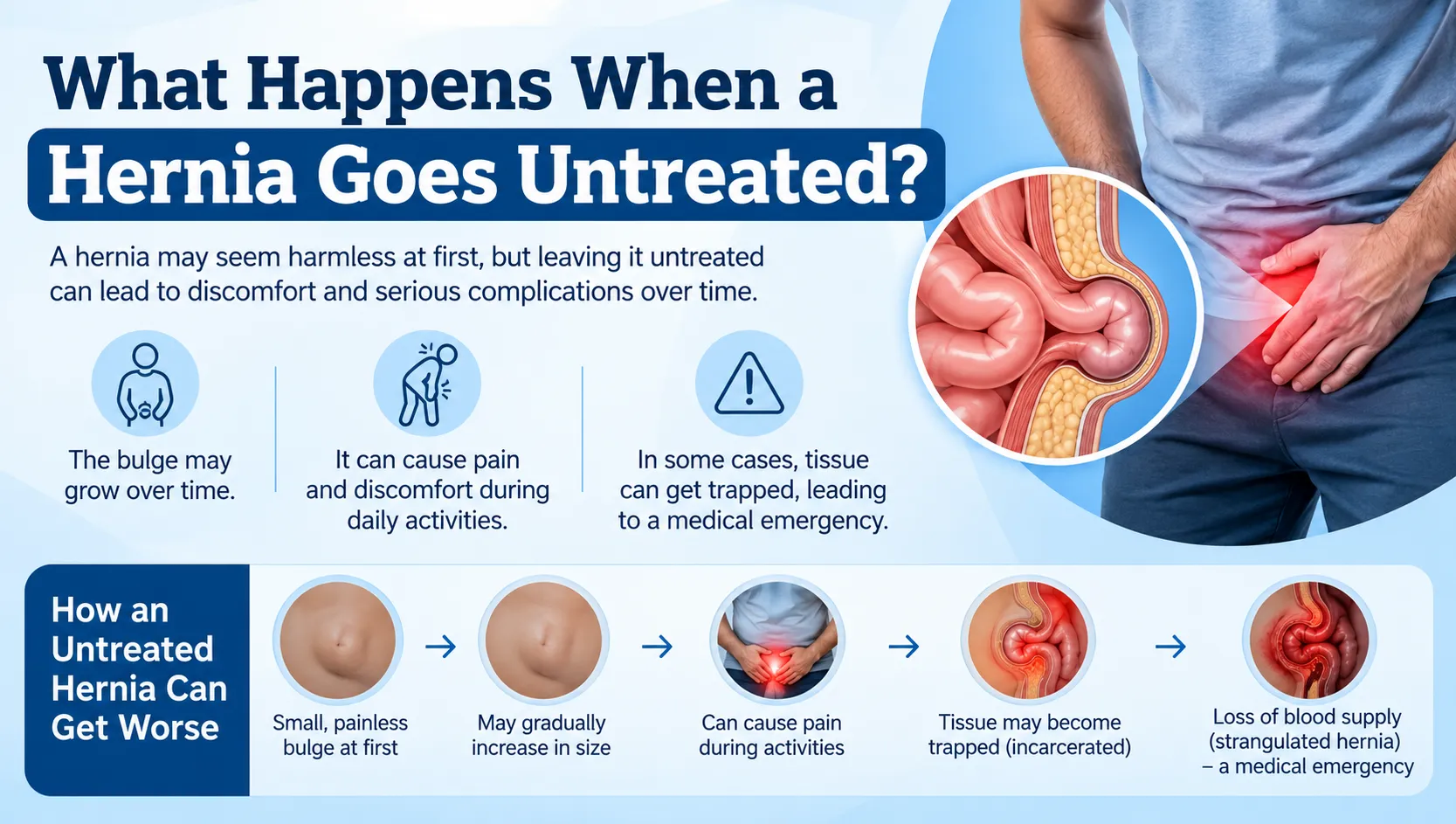
A hernia may seem harmless when the lump is small and painless, but leaving a hernia untreated can sometimes lead to complications. In some cases, the bulge may grow or cause discomfort during daily activities. More seriously, tissue trapped inside the hernia can lose its blood supply, leading to a medical emergency.
Not every hernia requires immediate surgery, but a medical evaluation can help determine whether monitoring or surgical repair is appropriate.
Can a Hernia Get Worse If You Leave It Untreated?
For some individuals, a hernia may be present for quite some time before problems begin to arise. To begin with, there may just be a minor bulge located close to the navel area or the groin area. This bulge may appear when someone coughs or lifts an object, and then it becomes less prominent while at rest.
However, over time this bulge may grow in size. There will be pain experienced by the individual whenever he walks, bends or engages in regular activities. Sometimes, this hernia does not change at all for several years. There is no telling what will happen in the future unless a medical professional examines the problem.
What Can Happen If a Hernia Is Left Untreated?
The condition of a hernia may get worse as time passes. The swelling may increase and activities such as walking and lifting weights may cause pain. However, a more serious complication occurs when the tissue contained in the hernia becomes trapped.
In some cases, a portion of the intestine may be trapped and prevented from being pushed back into the abdominal cavity. When this prevents the flow of blood to the tissue, the tissue becomes damaged and causes intense pain, nausea, and a hard, painful lump. This is a medical emergency requiring surgery and does not occur in every case of hernia.
When Does a Hernia Need Immediate Medical Attention?
You should not ignore a hernia when it suddenly starts becoming painful and hard compared to its usual texture. If it fails to return into place as it used to, one must be careful since it could be a sign that some tissues have become entrapped in the hernia.
Severe abdominal pain, nausea, swelling, inability to defecate and pass gas are other signs of a strangulated hernia. Also, the skin covering the bulge can get discolored. One should immediately rush to the nearest hospital upon noticing any of these signs and symptoms.
Does Every Hernia Need Surgery?
However, not all hernias have to be operated on at once. If the protrusion is small and is not causing pain, your doctor might advise you to observe the situation for some time. This method applies particularly to some types of hernia in adults.
On the other hand, in cases when the protrusion gets bigger, begins to hurt, or interferes with performing everyday actions, surgery should be considered as well. Also, the type of hernia and the patient's general state should be taken into account while choosing the method of treatment.
Though there is no immediate need for surgery, a checkup is definitely beneficial. Delaying the visit to the doctor without any reason can lead to missing signs of the condition's development.
What Are the Treatment Options for a Hernia?
If a hernia needs surgery, the surgeon repairs the weak area and puts the bulging tissue back in place. The surgery may be done in different ways, depending on the size and location of the hernia and the patient's health.
|
Type of Surgery |
How It Is Done |
|
Open Hernia Surgery |
The surgeon makes a cut near the hernia and repairs the weak area. A surgical mesh may be used to strengthen it. |
|
Laparoscopic Hernia Surgery |
The surgeon makes a few small cuts and uses a camera and special instruments to repair the hernia. |
|
Robotic Hernia Surgery |
The surgeon controls special instruments through a robotic system. This allows precise movements during the repair and may be suitable for some patients. |
Not every patient needs the same type of surgery. The surgeon will suggest an option after checking the hernia, the patient's health, and any previous surgeries.
What Can You Do to Avoid Making a Hernia Worse?
Having a hernia does not mean you have to put an end to all of your activities. There are several steps you can take to be comfortable, but they will not make the hernia go away.
-
Take note of what you lift: If lifting a heavy object like a bucket or a bag causes you pain in the area of the lump, then do not lift these kinds of objects before consulting your physician.
-
Try not to strain while defecating: Hard stools and constipation will cause additional pressure on your abdomen. Consume more fruit, vegetables, and whole grain foods along with drinking plenty of water.
-
Check your cough: Frequent coughing may cause constant pressure on the weakened part of your abdomen.
-
Maintain your body weight: Being overweight may put pressure on your abdominal muscles.
-
Consult your doctor regarding physical activity: You may be able to continue walking and exercising in general. This issue can be discussed with your doctor.
All of these measures may help in easing your condition, but they will not seal the hole where the tissue comes out. If your lump gets larger or painful, consult your physician.
Conclusion
A hernia may remain painless for some time, but it can grow or develop complications in certain cases. A new or enlarging lump around the abdomen, belly button, or groin should be evaluated by a medical professional, even if it does not hurt.
Treatment depends on the hernia's type, size, symptoms, and the patient's overall health. Dr. Rajesh, a General Surgeon in Gurgaon with over 13 years of experience, provides consultation for hernia evaluation and surgical treatment options to help patients understand the most appropriate approach for their condition.
If a hernia suddenly becomes very painful, hard, or discoloured, or is accompanied by vomiting, seek emergency medical care immediately.
Frequently Asked Questions
Can a hernia become dangerous if untreated?
Yes, it can. While some hernias remain the same size throughout their life, some grow in size and even begin to cause pain. Some hernias might be stuck in place, and that will require emergency surgery.
How do you tell that your hernia is serious?
If you notice that your hernia suddenly hurts a lot, becomes very hard, causes vomiting, or changes the color of the skin around the hernia, it is considered an urgent problem. If the lump has become painful and doesn’t go away, consult the doctor as soon as possible.
Can a hernia heal by itself without surgery?
No, it can’t. If the hernia is small and isn’t causing any pain, the doctor might advise you to undergo regular check-ups rather than operate.
Is it okay to work out when you have a hernia?
This will depend on how big the hernia is and whether or not it is painful. Some individuals may find walking easy, but they should not engage in strenuous exercises which could cause them pain.
When should you visit a surgeon regarding a hernia?
See a surgeon if you have a bump around your belly button, abdomen, or groin, despite it not being painful. You should go to the hospital urgently if you experience pain, vomiting, and hard and discoloured bumps.