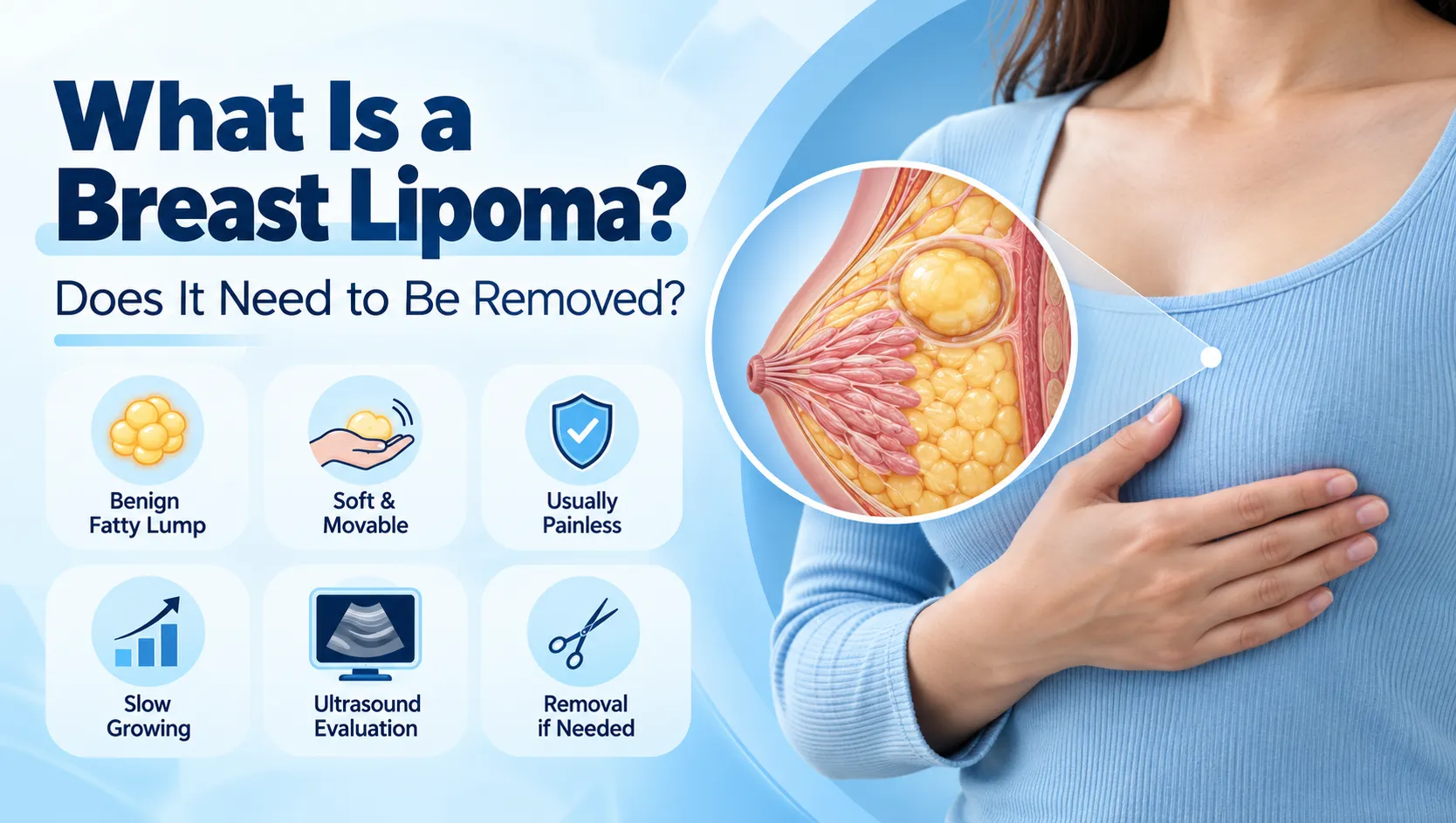
A breast lipoma is a non-cancerous lump made of fatty tissue that develops within or just beneath the breast tissue. It usually feels soft, smooth, and movable under the skin and often grows slowly over time.
Most breast lipomas do not cause serious problems and do not always need to be removed. However, removal may be considered if the lump is growing, painful, causing discomfort, affecting the shape of the breast, or if the diagnosis is uncertain.
Because many different conditions can cause a breast lump, any new or changing lump should be properly evaluated rather than assumed to be a lipoma.
What Is a Breast Lipoma?
A lipoma is a benign growth made up of mature fat cells.
When it develops in the breast, it is called a breast lipoma. It may occur within the breast tissue or in the fatty layer underneath the skin.
Breast lipomas are usually:
-
Soft
-
Smooth
-
Painless
-
Slow-growing
-
Easily movable under the skin
-
Round or oval in shape
They can vary considerably in size.
Is a Breast Lipoma Cancerous?
No. A typical breast lipoma is a benign or non-cancerous growth.
A lipoma itself does not normally become breast cancer.
However, not every breast lump is a lipoma. Fibroadenoma, cysts, fat necrosis, infections, and breast cancer can also present as breast lumps.
That is why a new breast lump should be assessed properly before confirming the diagnosis.
What Does a Breast Lipoma Feel Like?
A breast lipoma commonly feels like a:
-
Soft or rubbery lump
-
Smooth swelling
-
Movable lump
-
Painless mass
-
Lump with clearly defined edges
It may move slightly when pressed with the fingers.
However, the feel of a lump alone is not enough to confirm that it is a lipoma.
What Causes a Breast Lipoma?
The exact cause of lipomas is not always known.
Some factors that may be associated with lipoma formation include:
-
Genetic tendency
-
Family history of lipomas
-
Age-related changes in fatty tissue
-
Certain inherited conditions
Lipomas are generally not caused by eating fatty foods.
Being overweight can increase the amount of body fat, but this does not necessarily mean that a lipoma developed because of obesity.
Who Can Develop a Breast Lipoma?
Breast lipomas can occur in adults of different age groups.
They may be discovered:
-
During self-examination
-
During a routine medical examination
-
On breast ultrasound
-
During mammography performed for another reason
They are often found incidentally because many do not cause symptoms.
Can a Breast Lipoma Cause Pain?
Most breast lipomas are painless.
Pain may occur if:
-
The lipoma becomes large
-
It presses on nearby tissue
-
There is irritation in the surrounding area
-
Another breast condition is present at the same time
A painful breast lump should be evaluated because pain can have many causes other than lipoma.
Can a Breast Lipoma Grow Bigger?
Yes. A lipoma may gradually increase in size over time.
Many lipomas grow very slowly, while some remain almost unchanged for years.
A lump that is growing rapidly should be reassessed because rapid growth is not typical of a simple lipoma.
Can a Breast Lipoma Go Away on Its Own?
A breast lipoma usually does not disappear completely on its own.
Small lipomas may remain stable for many years without causing any problems.
If the diagnosis is confirmed and there are no troublesome symptoms, observation may be all that is required.
Can Weight Loss Make a Breast Lipoma Smaller?
Weight loss may reduce overall body fat, but it usually does not make an established lipoma disappear.
A lipoma is a localized collection of fatty tissue surrounded by a thin capsule.
Its size may not change significantly even if a person loses weight.
Breast Lipoma vs Fibroadenoma
Both conditions can cause a movable breast lump, but they are different.
Breast Lipoma
A lipoma is made mainly of fatty tissue.
It is generally:
-
Soft
-
Painless
-
Slow-growing
-
Movable
Fibroadenoma
A fibroadenoma is made of fibrous and glandular breast tissue.
It often feels:
-
Firm
-
Rubbery
-
Smooth
-
Well-defined
-
Movable
Clinical examination and imaging help distinguish between the two.
Breast Lipoma vs Breast Cyst
A breast cyst is a fluid-filled sac, while a lipoma is made of fatty tissue.
A cyst may:
-
Change in size
-
Become tender
-
Feel more noticeable around hormonal changes
A lipoma generally remains soft and gradually changes in size.
Ultrasound can help determine whether a lump is solid or fluid-filled.
Breast Lipoma vs Breast Cancer
A typical lipoma is benign, but it is important not to diagnose a breast lump based only on touch.
Some concerning features of a breast lump may include:
-
Hard or irregular shape
-
Fixed lump
-
Rapid increase in size
-
Skin dimpling
-
Nipple changes
-
Bloody nipple discharge
-
Persistent swelling
-
Enlarged lymph nodes
These signs do not always mean cancer, but they require proper evaluation.
How Is a Breast Lipoma Diagnosed?
Diagnosis generally begins with medical history and physical examination.
The doctor may ask:
-
When the lump was first noticed
-
Whether it has increased in size
-
Whether it is painful
-
Whether there are nipple or skin changes
-
Whether there is a family history of breast disease
Further tests may be advised if needed.
Can Ultrasound Detect a Breast Lipoma?
Yes. Breast ultrasound is commonly used to evaluate a breast lump.
It can help determine:
-
Whether the lump is solid
-
Its size
-
Its location
-
Its internal appearance
-
Whether it has features typical of a lipoma
Ultrasound is particularly useful for evaluating palpable breast lumps.
Does a Breast Lipoma Need a Biopsy?
Not always.
If examination and imaging clearly suggest a benign lipoma, biopsy may not be required.
However, a doctor may recommend tissue sampling if:
-
The diagnosis is uncertain
-
Imaging is not typical
-
The lump is growing
-
The lump is firm or irregular
-
There are other concerning changes
The purpose of biopsy is to confirm the nature of the lump when necessary.
Does a Breast Lipoma Need to Be Removed?
No. Not every breast lipoma needs surgery.
If the lump is small, painless, stable, and confirmed to be benign, the doctor may recommend observation.
Removal may be considered when:
-
The lipoma is increasing in size
-
It causes pain or pressure
-
It causes visible breast asymmetry
-
It interferes with clothing or daily activities
-
The diagnosis is uncertain
-
The patient is uncomfortable with the lump
-
The lump is unusually large
The decision should be individualized.
What Size Breast Lipoma Should Be Removed?
There is no single size at which every breast lipoma must be removed.
Doctors consider several factors rather than size alone, including:
-
Rate of growth
-
Symptoms
-
Location
-
Appearance on imaging
-
Effect on breast shape
-
Diagnostic certainty
Even a smaller lump may need removal if its diagnosis is unclear, while a larger but stable benign lipoma may sometimes be observed.
How Is Breast Lipoma Removed?
Surgical removal is usually performed through a small incision over or near the lump.
The surgeon carefully separates the lipoma from the surrounding tissue and removes it.
The removed tissue may be sent for laboratory examination to confirm the diagnosis.
The exact procedure depends on:
-
Size of the lipoma
-
Depth
-
Location
-
Number of lipomas
-
Cosmetic considerations
Is Breast Lipoma Removal Painful?
The procedure is usually performed with appropriate anesthesia.
Patients should not feel significant pain during the operation.
Some soreness, swelling, or mild discomfort may occur for a few days afterward and can usually be managed with medicines prescribed by the doctor.
How Long Does Breast Lipoma Removal Take?
Smaller and superficial lipomas may often be removed relatively quickly.
Larger or deeper lipomas may require more time.
The procedure duration varies depending on the size and location of the lump.
What Is Recovery Like After Breast Lipoma Removal?
Recovery is generally straightforward for a simple lipoma removal.
Patients may experience:
-
Mild pain
-
Swelling
-
Bruising
-
Tightness around the incision
The doctor may advise:
-
Keeping the wound clean and dry
-
Avoiding strenuous activity for a short period
-
Taking prescribed pain medicines
-
Returning for follow-up
-
Watching for infection or unusual swelling
Most patients can resume routine activities according to their surgeon's advice.
Can Breast Lipoma Come Back After Removal?
Recurrence after complete removal is uncommon, but it can occur.
Sometimes another lipoma may develop in a different area.
If a lump returns at the same location, it should be examined again.
Can Multiple Breast Lipomas Occur?
Yes. Some people may develop more than one lipoma.
Multiple lipomas may occur in the breast or elsewhere in the body.
A family history of multiple lipomas can sometimes be present.
When Should You See a Doctor for a Breast Lump?
Seek medical evaluation if you notice:
-
A new breast lump
-
A lump that is increasing in size
-
A hard or fixed lump
-
Persistent breast pain
-
Skin dimpling
-
Redness or swelling
-
Changes in the nipple
-
Bloody nipple discharge
-
Change in breast shape
-
A lump in the armpit
Most breast lumps are not cancerous, but proper evaluation is important to determine the cause.
Conclusion
A breast lipoma is usually a non-cancerous fatty lump that may remain small and symptom-free for a long time. In many cases, treatment is not required unless the lump increases in size, becomes painful, causes discomfort, or affects the appearance of the breast.
Because breast lumps can develop for different reasons, proper evaluation is important before deciding whether observation or removal is appropriate. If a lump is new, changing, or causing concern, it should be examined by a doctor.
Dr. Rajesh, General Surgeon in Gurgaon, provides consultation for breast lumps, lipomas, and other general surgical conditions, with treatment planned according to the individual diagnosis and symptoms.
Frequently Asked Questions
1. Is breast lipoma dangerous?
A typical breast lipoma is benign and usually not dangerous.
2. Can breast lipoma become cancer?
A simple lipoma does not normally become breast cancer, but any changing breast lump should be evaluated.
3. Does breast lipoma always need surgery?
No. Small, painless, stable lipomas may only require observation.
4. Can breast lipoma grow bigger?
Yes. Some lipomas gradually increase in size over time.
5. Can breast lipoma disappear naturally?
Usually not. Lipomas generally remain unless they are surgically removed.
6. Can breast lipoma cause pain?
Most are painless, but larger lipomas may sometimes cause pressure or discomfort.
7. Is ultrasound enough to diagnose breast lipoma?
Ultrasound can be very helpful, but additional imaging or biopsy may be recommended depending on the findings.
8. Does a breast lipoma need biopsy?
Not every lipoma requires biopsy. It may be recommended when the diagnosis is uncertain.
9. Can breast lipoma return after surgery?
Recurrence after complete removal is uncommon, although another lipoma can develop elsewhere.
10. Which doctor treats breast lipoma?
A general surgeon or breast surgeon can evaluate a breast lipoma and advise whether observation or removal is appropriate.