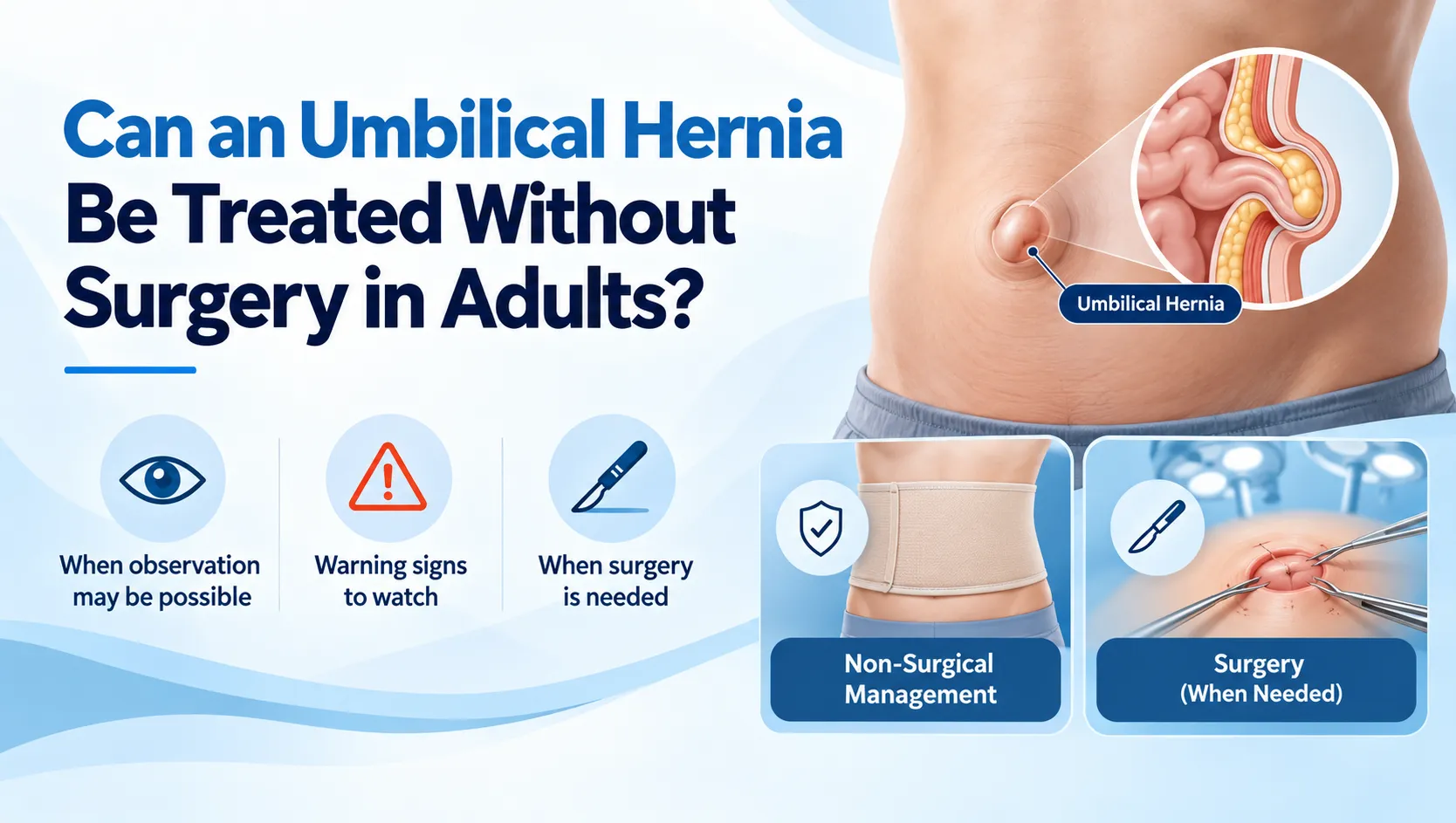
An umbilical hernia in adults cannot be cured or healed without surgery because it is caused by a structural weakness or defect in the abdominal wall that does not close on its own. However, this does not mean that every adult with an umbilical hernia needs immediate surgery.
If the hernia is small, causes little or no discomfort, remains stable in size, and can easily move back inside, a surgeon may sometimes recommend observation and regular follow-up. Lifestyle changes may help reduce pressure on the abdomen and control symptoms, but they do not repair the hernia itself.
Surgery may be considered if the hernia becomes painful, grows larger, interferes with daily activities, or shows signs of complications.
What Is an Umbilical Hernia?
An umbilical hernia develops when fat, tissue, or part of the intestine pushes through a weak area in the abdominal wall near the belly button.
It may appear as a soft bulge around the navel and can become more noticeable when you:
-
Cough
-
Laugh
-
Lift something heavy
-
Strain during bowel movements
-
Exercise
-
Stand for a long time
Some umbilical hernias remain small for years, while others may gradually increase in size.
Why Does an Umbilical Hernia Occur in Adults?
An adult umbilical hernia may develop when increased pressure inside the abdomen acts on a weak area around the belly button.
Common contributing factors include:
-
Obesity
-
Pregnancy
-
Multiple pregnancies
-
Chronic coughing
-
Long-term constipation
-
Frequent straining
-
Heavy lifting
-
Fluid accumulation in the abdomen
-
Previous abdominal surgery
-
Weakening of abdominal tissues with age
More than one factor may be present in the same patient.
Can an Umbilical Hernia Heal on Its Own in Adults?
Usually, no.
Unlike some umbilical hernias in young children, an adult umbilical hernia generally does not close naturally.
The opening in the abdominal wall remains present even if:
-
The pain improves
-
The swelling reduces while lying down
-
Weight is reduced
-
A hernia belt is used
-
Physical activity is modified
These measures may reduce symptoms but do not permanently repair the abdominal wall defect.
Can an Umbilical Hernia Be Managed Without Surgery?
Yes, some adults may be managed without immediate surgery.
A surgeon may consider observation if the hernia is:
-
Small
-
Painless or only mildly uncomfortable
-
Easily reducible
-
Not increasing in size
-
Not interfering with daily activities
-
Not showing signs of complications
Regular follow-up is important because symptoms and hernia size can change over time.
What Is Watchful Waiting?
Watchful waiting means monitoring the hernia instead of operating immediately.
During this period, patients should look for changes such as:
-
Increasing pain
-
Increasing size
-
Persistent swelling
-
Difficulty pushing the hernia back inside
-
Nausea
-
Vomiting
-
Abdominal bloating
Watchful waiting does not mean that the hernia has healed.
Can Medicines Cure an Umbilical Hernia?
No medicine can close the abdominal wall opening responsible for the hernia.
Medicines may help control associated problems such as:
-
Constipation
-
Chronic cough
-
Mild pain
-
Digestive discomfort
Treating these problems can reduce abdominal pressure, but the hernia itself remains.
Can Exercise Cure an Umbilical Hernia?
Exercise cannot permanently repair an existing umbilical hernia.
Regular physical activity may help maintain a healthy body weight and general fitness, but exercises that significantly increase abdominal pressure may worsen symptoms.
Activities that may need caution include:
-
Heavy weightlifting
-
Intense abdominal exercises
-
Repeated straining
-
High-pressure strength training
The safest activity level depends on the size of the hernia and the patient's symptoms.
Can You Go to the Gym With an Umbilical Hernia?
Some people with small, symptom-free hernias may continue light physical activity after medical evaluation.
However, heavy lifting may cause:
-
Increased bulging
-
More discomfort
-
Increased abdominal pressure
-
Gradual enlargement of the hernia
If pain or swelling develops during exercise, the activity should be stopped and medical advice should be sought.
Can Weight Loss Help an Umbilical Hernia?
Weight loss may help if a person is overweight because excess abdominal weight can place additional pressure on the abdominal wall.
Weight reduction may:
-
Reduce discomfort
-
Lower abdominal pressure
-
Improve overall health
-
Make future surgery safer if it becomes necessary
However, weight loss usually does not close an established umbilical hernia.
Does a Hernia Belt Cure an Umbilical Hernia?
No.
A hernia belt may provide temporary support in selected patients, but it does not repair the weakened abdominal wall.
A belt should not be used as a substitute for proper medical evaluation.
Long-term use without medical advice may also mask changes in the hernia that need attention.
Can Constipation Make an Umbilical Hernia Worse?
Yes.
Repeated straining during bowel movements increases pressure inside the abdomen.
This may make the hernia:
-
More noticeable
-
More uncomfortable
-
Gradually larger
Preventing constipation through adequate fluids, fiber, physical activity, and appropriate treatment may help reduce unnecessary straining.
Can Heavy Lifting Make an Umbilical Hernia Bigger?
Heavy lifting can increase pressure inside the abdomen.
If there is already a weak area near the belly button, repeated heavy lifting may make the bulge more prominent or increase discomfort.
Patients with an umbilical hernia should discuss safe lifting limits with their doctor.
What Happens If an Umbilical Hernia Is Left Untreated?
Some small hernias may remain stable for a long time.
Others may gradually:
-
Increase in size
-
Become painful
-
Become difficult to push back inside
-
Affect exercise or work
-
Cause recurrent discomfort
In some cases, tissue or intestine can become trapped inside the hernia.
What Is an Incarcerated Umbilical Hernia?
An incarcerated hernia occurs when tissue becomes trapped in the hernia and cannot move back into the abdomen.
Possible symptoms include:
-
Persistent painful swelling
-
Increased tenderness
-
A firm bulge
-
Nausea
-
Vomiting
An incarcerated hernia requires prompt medical assessment.
What Is a Strangulated Umbilical Hernia?
A strangulated hernia occurs when the blood supply to trapped tissue becomes reduced or blocked.
This is a medical emergency.
Possible warning signs include:
-
Sudden severe abdominal pain
-
A hard and very tender bulge
-
Redness or discoloration over the hernia
-
Repeated vomiting
-
Abdominal swelling
-
Inability to pass stool or gas
Urgent treatment may be necessary.
When Is Surgery Recommended for an Umbilical Hernia?
Surgery may be recommended when:
-
The hernia is painful
-
The swelling is getting bigger
-
Symptoms are becoming more frequent
-
The hernia affects daily activities
-
It becomes difficult to push back inside
-
The hernia becomes incarcerated
-
There is concern about strangulation
-
The patient prefers definitive repair
The decision depends on symptoms, hernia size, general health, and examination findings.
How Is Umbilical Hernia Surgery Performed?
The aim of surgery is to return the protruding tissue to the abdomen and repair the weakness in the abdominal wall.
Open Hernia Repair
A small incision is made near the belly button.
The hernia is repaired and the abdominal wall is strengthened using stitches or mesh when appropriate.
Laparoscopic Hernia Repair
Small incisions are used to insert a camera and surgical instruments.
The hernia is repaired from inside the abdomen.
Robotic Hernia Repair
In selected cases, robotic-assisted surgery may be used for umbilical or ventral hernia repair.
The choice of technique depends on the hernia size, complexity, previous surgery, and the surgeon's evaluation.
Is Mesh Always Needed for Umbilical Hernia Surgery?
No.
Whether mesh is needed depends on:
-
Size of the hernia
-
Risk of recurrence
-
Tissue quality
-
Previous hernia repair
-
Overall health
Smaller defects may sometimes be repaired with stitches, while mesh may be recommended for larger defects or where recurrence risk is higher.
How Long Does Recovery Take After Umbilical Hernia Surgery?
Recovery varies from patient to patient.
It depends on:
-
Hernia size
-
Surgical technique
-
Type of work
-
Overall health
-
Whether complications were present
Patients are often encouraged to start walking soon after surgery.
Heavy lifting and strenuous activity are usually restricted temporarily according to the surgeon's advice.
Can an Umbilical Hernia Come Back After Surgery?
Yes, recurrence is possible after any hernia repair, although proper repair and risk-factor control can reduce the chance.
Factors that may increase recurrence risk include:
-
Obesity
-
Smoking
-
Chronic coughing
-
Constipation
-
Repeated heavy lifting
-
Poor wound healing
Following post-operative instructions is important.
When Should You See a Doctor?
You should arrange medical evaluation if you notice:
-
A new bulge near the belly button
-
Increasing hernia size
-
Persistent discomfort
-
Pain while coughing or lifting
-
Difficulty pushing the hernia back inside
-
Recurrent swelling
Seek urgent medical care if there is:
-
Sudden severe pain
-
A hard, painful bulge
-
Repeated vomiting
-
Abdominal swelling
-
Redness or discoloration over the hernia
-
Inability to pass stool or gas
Conclusion
An umbilical hernia in adults usually cannot be permanently cured without surgery, because the weakness in the abdominal wall remains present. However, small and minimally symptomatic hernias may sometimes be monitored under a surgeon's guidance rather than operated on immediately.
Lifestyle measures such as maintaining a healthy weight, managing constipation, treating chronic cough, and avoiding unnecessary straining may help reduce symptoms and pressure on the hernia, but they do not close the defect.
If the hernia becomes painful, increases in size, cannot be pushed back inside, or causes vomiting or severe abdominal symptoms, medical evaluation should not be delayed.
Dr. Rajesh, General Surgeon in Gurgaon, provides evaluation and surgical consultation for umbilical, inguinal, ventral, and other abdominal wall hernias.
Frequently Asked Questions
1. Can an umbilical hernia in adults go away naturally?
Adult umbilical hernias generally do not close on their own.
2. Does every adult umbilical hernia need surgery?
No. Some small and symptom-free hernias may be monitored after proper medical evaluation.
3. Can medicines cure an umbilical hernia?
No. Medicines can help manage associated symptoms but cannot repair the abdominal wall defect.
4. Can weight loss fix an umbilical hernia?
Weight loss may reduce abdominal pressure and symptoms but usually does not close the hernia.
5. Is it safe to exercise with an umbilical hernia?
Light activity may be possible in some patients, but heavy lifting and straining should be discussed with a doctor.
6. Can an umbilical hernia become dangerous?
Yes. In some cases, tissue or intestine may become trapped or lose its blood supply.
7. How do I know if my umbilical hernia is trapped?
A painful bulge that cannot be pushed back inside, especially with vomiting or abdominal swelling, requires prompt assessment.
8. Can I use a hernia belt instead of surgery?
A hernia belt may provide temporary support but does not cure the hernia.
9. Can constipation worsen an umbilical hernia?
Yes. Repeated straining can increase abdominal pressure and worsen symptoms.
10. Which doctor treats an umbilical hernia?
A general surgeon or hernia surgeon can evaluate an adult umbilical hernia and recommend appropriate treatment.